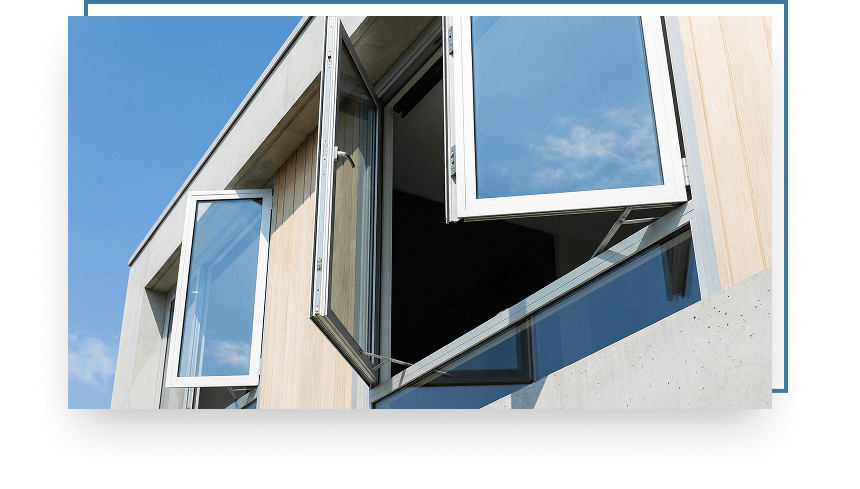
Opens outward up to 90 degrees

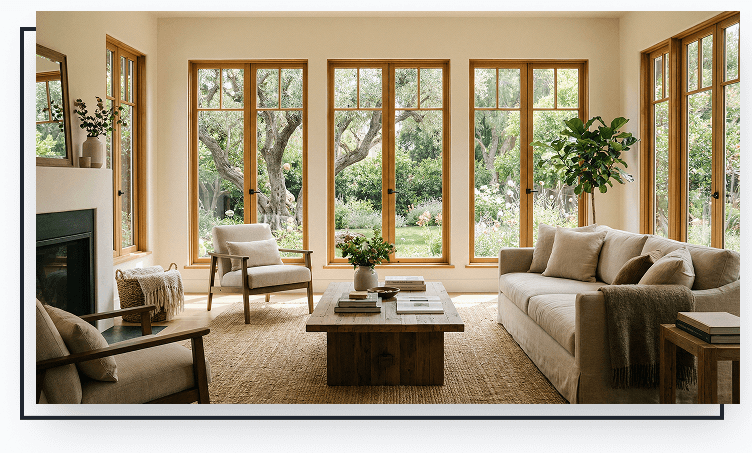
No center rail to block sightlines
Refrigerator-type bulb seals, multi-chamber extrusion design, and double or triple stacked Low-E glass filled with Argon or Krypton gas.

Single-point lock mechanism and tempered safety glass for peace of mind.

Colonial or diamond grids, simulated wood interior finishes, and polymer exterior color finishes.

Designed with an airtight seal, they provide superior insulation, structural rigidity, and enhanced energy savings by maintaining lower U-factors and better gas retention.

The invisible Thermal blanket reflects UV rays and heat, keeping your home comfortable and protecting interiors from fading.

Easy to open and close, these windows are both practical and safe, with features that ensure accident prevention and added security.
Replacement casement windows suit rooms where you want the whole opening clear for airflow, and they seal tighter than any sash window when closed.
A casement is hinged at the side and cranks outward, which produces two things no sliding or hung window can match. The whole opening clears, so you get close to one hundred percent of the aperture as ventilation rather than the half a double hung gives you. And when it closes, the sash pulls against a compression seal all the way round, which is why casements consistently test as the tightest operating window you can buy.
In this climate that seal is the real argument. Kansas City wind drives rain horizontally against a west elevation several times a year, and a compression seal handles that in a way a sliding seal simply does not. The trade-off is that the sash swings out into the world, so it is wrong above a walkway, a deck rail or anywhere it becomes an obstacle.
Two practical points. First, screens sit on the inside, which some homeowners dislike because the screen is between you and the glass. Second, the crank mechanism is a moving part under load, so it is the component that eventually needs service on a casement. Neither is a reason to avoid the style, but a salesperson who does not mention them is selling rather than advising.
There is a practical limit, because the wider the sash the more leverage it puts on the hinges and the crank. Past that point we would specify a pair of casements or a casement flanking a picture window rather than one oversized sash that will sag.
Closed, they are the best performer you can fit. Open, an unexpected gust can catch the sash, so the mechanism should never be left cranked wide open on a storm day. That is an operating habit rather than a product weakness.
Usually somewhat, because of the hardware. Whether that is worth it depends on the opening. On a kitchen window over a sink, or on a wall that takes weather, most homeowners find the difference easy to justify.
The single most common place we fit casements is a kitchen window above a sink. Reaching across a counter and a faucet to lift a heavy double hung sash is awkward enough that most homeowners simply stop opening the window. A crank at the bottom of the frame is reachable from a normal standing position, which is the difference between a window that gets used and one that does not.
The same logic applies over a bath, behind a fixed counter, or in any opening set high in the wall. It is worth thinking about which side the hinge goes on before you order. Hinge it so the open sash deflects the prevailing breeze into the room rather than shielding it, and so the crank is on the side you can actually reach past whatever is in front of the window.